
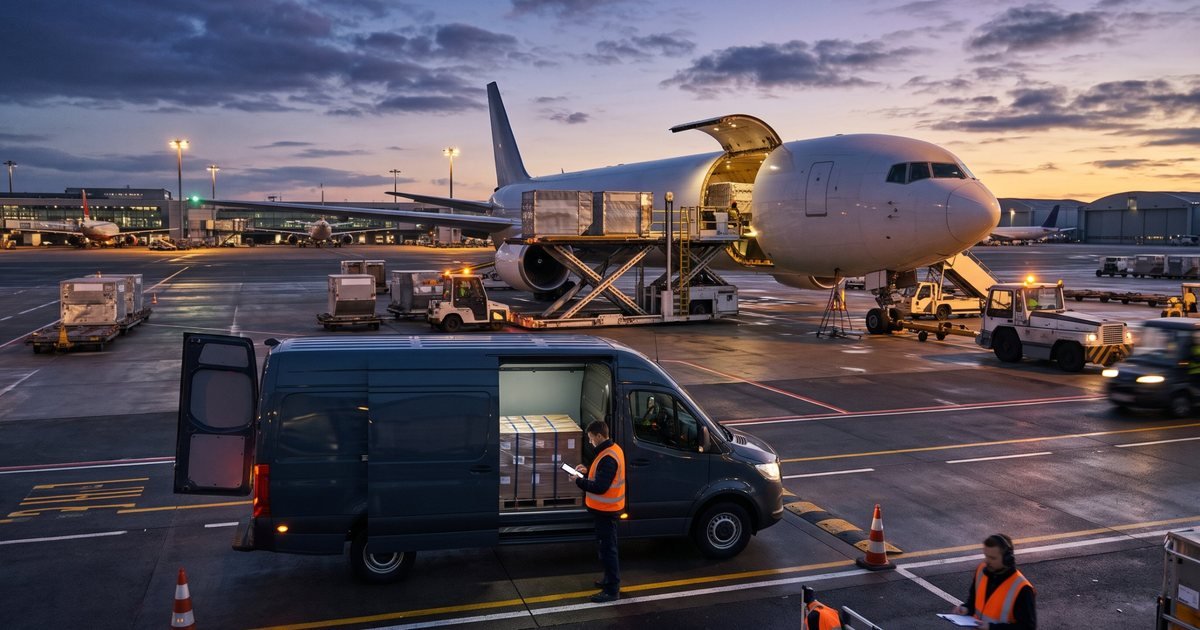
As maritime disruption keeps pushing part of industrial flows towards the air, air capacity between Europe and Africa is tightening, and the shortage of freighter aircraft is expected to last into 2027. A complex equation for the automotive and aerospace sectors, which have to operate on just-in-time supply chains.
What the figures say
In its third-quarter 2026 review (Air Freight Market Update, published on 18 November 2026), DHL Global Forwarding notes that the Middle East and Africa region is the only one where air capacity is falling — by 3% in September compared with a year earlier, mainly on the European corridor — while spot rates to Africa are up 31% year on year. A few days earlier, Henk Venema, Global Head of Air Freight at DHL Global Forwarding, warned that freighter tightness would last into 2027: only about twenty deliveries are expected, mostly for express integrators.
In the background, tensions in the Red Sea keep alternative routings in place. Diversions around the Cape of Good Hope still tie up 5 to 7% of global container ship capacity (Linerlytica, September 2026) and add roughly ten days to an Asia – Northern Europe round trip, even though several carriers (CMA CGM, Maersk, MSC) are gradually returning via Suez. To avoid production stoppages, some industrial shippers are therefore moving part of their urgent supplies to air. Yet according to IATA, air cargo demand for African carriers rose 4.7% year on year in September 2026, while their capacity fell 1.2%: the load factor gained 2.7 points, to 47%.
The paradox of Euro-African industrial chains
In recent years, nearshoring strategies have strongly reinforced industrial integration between Europe, Morocco and Tunisia, notably in automotive wiring, electronics and aerospace subcontracting. While this proximity shortens distances, it also demands tighter synchronisation of flows: a component blocked or delayed by 24 hours can be enough to stop an assembly line.
When capacity shrinks on the European corridor, traditional air freight — which relies on consolidation and routings through large international hubs — becomes particularly vulnerable to offloads and connection problems. The IATA and DHL figures converge: demand keeps growing on Africa while supply is contracting.
Towards hybrid emergency set-ups
For Supply Chain directors, the challenge is no longer just buying capacity for the year, but building agile workarounds for when something breaks. Three practices are gradually becoming standard among industrial shippers:
- Dedicated express road transport. A vehicle assigned to a single shipment, with no consolidation or transhipment, can deliver a critical part directly, from one site to another or to the best-placed departure airport. Bypassing the major hubs by road to less congested regional European airports often gives a better boarding guarantee and shortens ground handling times.
- Hand Carry (OBC) as a complement. When cargo holds are saturated, using passenger airline networks through a dedicated courier can deliver critical parts within hours, avoiding standard cargo processing times and the risk of priority offloading.
- Real-time data steering. Faced with uncertain lead times, shippers now favour providers able to offer granular, milestone-by-milestone traceability rather than simple after-the-fact administrative tracking.
“On corridors as sensitive as the Europe–Maghreb axis, performance is no longer decided by the rate per kilo alone, but by the ability to trigger a plan B in under two hours with full visibility for the receiving plant.”
As 2027 approaches, securing air corridors is becoming a strategic topic of the first order, well beyond the transport operations teams alone.
Sources
- DHL Global Forwarding — Air Freight Market Update: third-quarter 2026 review (18 November 2026): Middle East and Africa capacity, spot rates, freighter tightness.
- Air Cargo News — DHL Forwarding warns that market-wide growth hides trade lane disparities (13 November 2026): Henk Venema column, 2027 outlook for freighters.
- IATA — Air Cargo Demand Accelerates in September, Up 7.7% (29 October 2026): demand, capacity and load factor of African carriers.
- Seatrade Maritime — Container lines edge towards full Suez and Red Sea return (1 September 2026): Cape diversions and carriers’ gradual return via Suez (Linerlytica data).
Need to assess a contingency plan for your Europe – Africa / Maghreb flows?
Our operations desk, dedicated to industrial emergencies (express road transport, dedicated vehicle, OBC / Hand Carry, critical air freight), is available 24/7: ops@nova-sas.fr.